
Built-In Clip Mechanism
Each bracket has its own sliding door or spring clip that holds the archwire without elastic ties — eliminating tie friction entirely.
Self-ligating braces use a built-in bracket clip instead of elastic ties — reducing friction, shortening adjustment visits, and delivering precise orthodontic correction for the full range of alignment concerns.
Comparing advanced braces options? Review metal braces, ceramic braces, and clear aligners to compare appointment frequency, visibility, and treatment style.
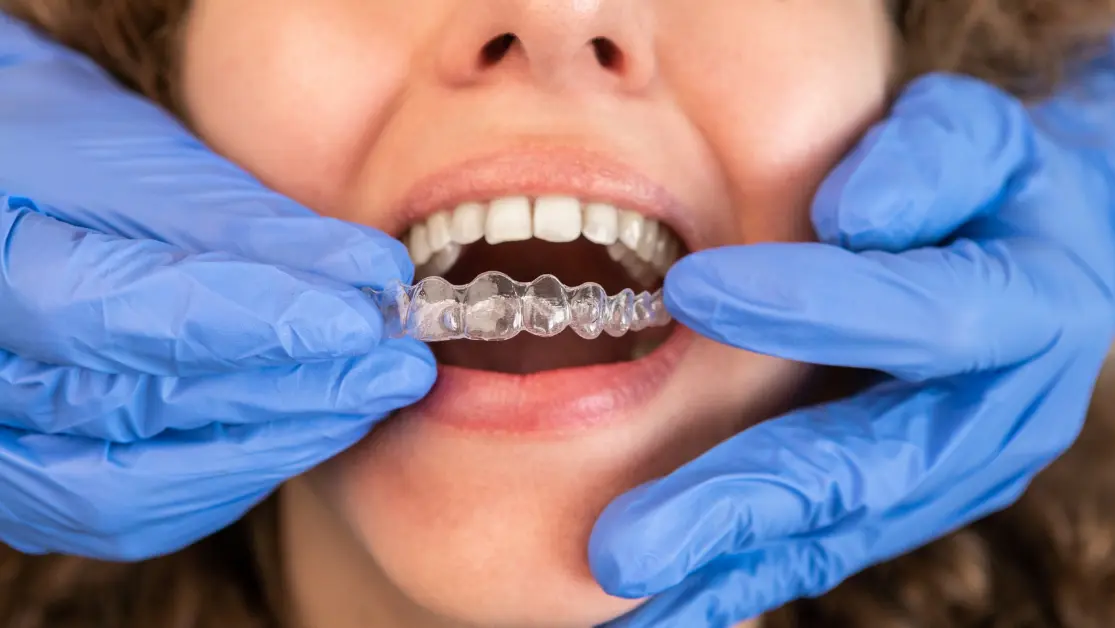
In conventional braces, small elastic ties hold the archwire in each bracket. Over time these ties create friction against the wire and must be replaced at every adjustment appointment. Self-ligating braces replace the elastic tie with a built-in sliding door or spring clip that is part of the bracket itself.
When the clip is closed, the wire is held securely but with significantly less friction than elastic ties allow. The wire can slide through the bracket as the teeth move, enabling a lighter, more continuous force. This can reduce soreness, speed up individual appointment times, and in some cases allow slightly longer intervals between adjustment visits.
Each bracket has its own sliding door or spring clip that holds the archwire without elastic ties — eliminating tie friction entirely.
Lower friction between wire and bracket means teeth can respond to lighter forces, which is often associated with less soreness during adjustments.
With no ties to remove and replace, adjustment visits are typically quicker — an advantage for patients with busy schedules.
Self-ligating brackets are available in both stainless steel and ceramic materials, so patients can choose between durability and esthetics according to their preference and clinical suitability.
Stainless steel self-ligating brackets are robust and the most affordable option. They provide full orthodontic control with the efficiency benefits of the self-ligating mechanism.
Tooth-coloured ceramic self-ligating brackets combine a less visible appearance with the low-friction clip system — a premium option for esthetic-conscious patients.
Passive clips allow the wire to slide freely with minimal force — ideal for initial alignment. Active clips apply a gentle directional force — useful for fine-tuning later in treatment.
Both metal and ceramic self-ligating brackets address mild, moderate, and complex crowding, spacing, and bite corrections with equivalent clinical capability.
Your dentist selects the bracket type — metal or ceramic, passive or active — based on your specific diagnosis, correction goals, and esthetic preferences.
Self-ligating brackets are used for children, teenagers, and adults. The efficiency advantages can be particularly appreciated by patients with demanding schedules.
The efficiency of self-ligating mechanics is only realised with accurate diagnosis and proper wire selection at each stage of treatment. Our orthodontic team has the clinical experience to plan and manage self-ligating braces cases from start to finish.
Each case is assessed by a dentist with orthodontic training who determines the right bracket system, wire sequence, and clinic schedule for your specific correction.
Clinical records, X-rays, and bite analysis inform an accurate diagnosis before bracket selection — ensuring the right mechanics are matched to your case.
We discuss metal versus ceramic self-ligating options and passive versus active bracket choice with you, based on your clinical needs and esthetic preferences.
Appointments are planned to take full advantage of the self-ligating mechanism — often shorter and spaced appropriately to allow effective tooth movement.
After treatment, a customised retainer plan maintains your alignment results. Wear schedule and retainer type are tailored to your case.
Our clinic is convenient for patients from Perumbakkam, Pallikaranai, Sholinganallur, and the OMR corridor — making scheduled visits practical.
Interested in efficient, comfortable orthodontic correction?
Book your assessment — our specialist will explain whether self-ligating braces suit your bite and give you a clear cost plan.
A structured treatment process delivers predictable results from diagnosis through to long-term retention.
Clinical examination, X-rays, photographs, and bite records are used to confirm suitability for self-ligating braces and plan the wire sequence and bracket positioning.
Self-ligating brackets are bonded with precision. You receive hygiene guidance, dietary instructions, and an adaptation care pack for the initial adaptation period.
Appointments are typically shorter than conventional braces. Wire changes and clip checks guide progressive tooth movement according to the planned sequence.
Once teeth reach their final planned positions, brackets are removed and the teeth are polished. A custom retainer is fitted with full wear instructions for long-term stability.
Cost depends on case complexity, bracket type (metal or ceramic), and treatment duration. We provide a transparent cost breakdown after your clinical assessment.
Metal Self-Ligating — Mild Correction
From ₹35,000
Metal Self-Ligating — Moderate Correction
From ₹50,000
Ceramic Self-Ligating — Mild Correction
From ₹45,000
Ceramic Self-Ligating — Moderate Correction
From ₹65,000
Retention (post-treatment)
Included in plan
Prices are indicative. Exact cost confirmed after clinical assessment. No-cost EMI options available.
Get your self-ligating braces cost estimate.
Patients across South Chennai trust Smile Squad for orthodontic care that is precise, comfortable, and designed around their individual needs.

Patient photos are shown with consent and represent individual outcomes.
Share your details and we'll call you back with a personalised cost breakdown and next-step guidance.
Common questions from patients across Medavakkam, Perumbakkam, Pallikaranai, and Sholinganallur.
Self-ligating braces use a built-in sliding clip or door mechanism on each bracket to hold the archwire, instead of the small elastic ties used in conventional braces. This reduces the friction between wire and bracket, allowing the wire to slide more freely as it guides teeth into position. The result is potentially smoother tooth movement, shorter adjustment appointments, and in some cases a reduced overall visit frequency.
Self-ligating brackets come in two types. Passive brackets have a slide that holds the wire loosely, allowing it to move freely — this reduces friction and is often used in the early stages of treatment. Active brackets have a spring clip that applies a small force to the wire, providing more control over tooth movement. Your dentist selects the bracket type best suited to your case.
Research shows that self-ligating braces are not consistently faster than conventional braces for most cases. However, individual adjustment visits are often shorter because there are no elastic ties to remove and replace. Some patients find the reduced appointment frequency and shorter visits more convenient. Total treatment time still depends primarily on case complexity.
Yes — self-ligating braces are available in both metal and ceramic (tooth-coloured) versions. Ceramic self-ligating brackets combine the low-friction mechanism with a less visible appearance, making them a good option for esthetic-conscious patients who want the benefits of self-ligating mechanics.
Many patients report that self-ligating braces feel more comfortable, particularly in the early weeks of treatment. The lower friction and gentle continuous force of self-ligating mechanics can mean less soreness after adjustments compared with conventional braces, though individual experience varies.
Self-ligating braces can treat the same range of cases as conventional braces — mild, moderate, and complex crowding, spacing, overbites, underbites, crossbites, and rotations. Suitability for self-ligating brackets versus conventional brackets depends on your specific bite and alignment diagnosis, which is assessed clinically before recommending a bracket type.
Self-ligating braces are typically priced slightly higher than conventional braces due to the more complex bracket design. Ceramic self-ligating brackets are priced higher again. Exact cost depends on your case complexity and the bracket type selected. We provide a transparent cost breakdown at your consultation after a full clinical evaluation.
Conventional metal braces remain the most widely used fixed orthodontic option — cost-effective, highly proven, and suitable for the full range of correction complexity.
See Metal Braces →Conventional ceramic braces use tooth-coloured brackets with elastic ties — a less visible fixed option at a lower cost than ceramic self-ligating brackets.
See Ceramic Braces →Clear aligners and Invisalign are completely removable alternatives for mild to moderate alignment cases — no brackets, no wires, and nearly invisible.
See Clear Aligners →Smile Squad Dental Clinic is in Medavakkam, Chennai — serving patients from Perumbakkam, Pallikaranai, Sholinganallur, and the OMR corridor. Book a consultation to find out whether self-ligating braces are the right choice for your alignment goals and schedule.